
There is a persistent myth in entrepreneurship: if a startup has a strong team, a solid business plan, thoughtful execution, and a genuine market need, success will naturally follow.
In healthcare AI, that is not how it works.
Some of the most promising companies in this space are not struggling because they lack vision, technical capability, or discipline. In many cases, they have exactly the right ingredients — experienced leadership, a clearly defined problem, a credible go-to-market strategy, active pilot conversations, detailed financial modeling, and technology built to meet real operational and clinical needs.
And yet the road remains exceptionally difficult. Not because the products are wrong. Because the environment around them is extraordinarily complex.
In healthcare AI, early-stage success is often determined not by the quality of the product, but by whether a company can navigate the structural barriers that exist between a good idea and a scalable business.
The Environment Is the Challenge
Healthcare is one of the most difficult industries in the world to build in. It is heavily regulated, operationally fragmented, financially constrained, and — for very good reasons — slow to adopt new technology. Healthcare organizations are making decisions that affect patient care, data privacy, compliance, clinical workflows, and long-term financial risk. Caution is not a flaw in that system. It is a feature.
But for early-stage companies, that caution has real consequences. Even an exceptional solution can face extended timelines before it reaches the point of meaningful adoption.
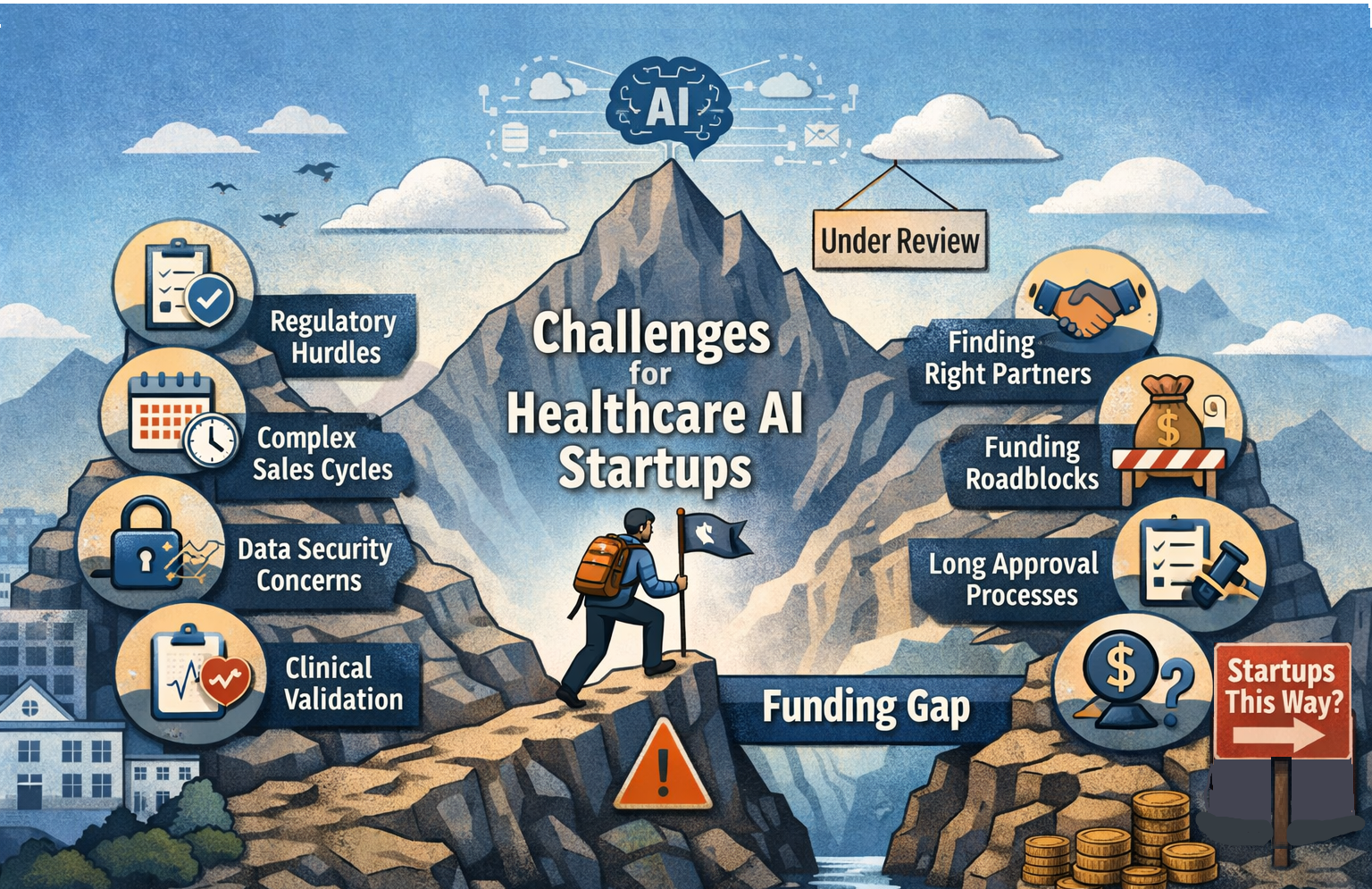
A new AI platform may genuinely address a pressing operational need — improving efficiency, reducing manual burden, expanding data utility, strengthening compliance, or opening new revenue pathways. Before it can scale, however, it must earn trust across a complex web of stakeholders: executives, IT and security teams, clinicians, compliance officers, legal counsel, procurement, and often a board. Each has different priorities. Each has a legitimate role in the decision.
That process takes time. Often far more time than early-stage companies can financially sustain.
Partnership Friction Is a Hidden — and Underestimated — Barrier
Finding the right partners is considerably harder than most outside observers recognize. Healthcare AI companies do not simply need customers. They need strategically aligned partners — organizations willing to think beyond short-term transactions and engage in meaningful, long-term collaboration.
That means identifying decision-makers who understand both the operational problem and the longer-term value proposition. It means working with institutions that are genuinely interested in innovation and capable of moving through internal review processes without stalling indefinitely. That combination is rarer than the market for healthcare AI would suggest.
Even when enthusiasm exists, internal complexity can dramatically slow momentum. A pilot that appears verbally supported may still require legal review, security assessment, technical validation, budget approval, executive sign-off, and operational prioritization — in sequence, and often without a predictable timeline. None of that signals a weak opportunity. It simply reflects the reality that healthcare moves carefully, and AI companies must be built to survive moving with it.
The startups best positioned to succeed in healthcare AI are not always the fastest-moving. They are often the ones built to endure.
The Funding Gap Is Real — and Structural
There is a common assumption that if a healthcare AI startup is well prepared, capital will follow. The reality is more complicated.
Investors frequently want to see traction, active pilots, revenue visibility, a defined market, and a realistic financial model. Yet healthcare AI companies often need capital precisely to reach those milestones. That creates a persistent and difficult gap: startups are expected to demonstrate market validation before they have been given the resources to achieve it at any meaningful scale.
Compounding this, healthcare AI companies frequently operate in longer sales cycles than software-focused investors prefer. Many are solving infrastructure, workflow, compliance, or data governance problems that are critically important but less immediately visible than consumer-facing applications. That makes them harder to evaluate quickly — even when the business case is genuinely strong.
The result is that highly credible companies can find themselves caught between competing investor profiles: too early for growth-stage investors, too operationally complex for generalist early-stage investors, and too innovative to fit cleanly into legacy healthcare funding patterns. It is a structural gap, not a reflection of the quality of the companies inside it.
The Burden of Continuous Proof
In most sectors, innovation is rewarded for speed. In healthcare, innovation is required to prove itself repeatedly — and at a higher standard — before it is taken seriously.
Healthcare AI companies must demonstrate not only that their technology works, but that it works securely, compliantly, consistently, and in a way that integrates into the realities of clinical and operational environments. They must address how data is handled, where risk lives, how workflows change, who benefits, how value is measured, and what responsible scale-up looks like — often all at the same time, and to multiple audiences with different levels of technical sophistication.
This level of scrutiny is warranted. Healthcare stakes are high. But it also means that companies in this space are building under a considerably heavier burden than their counterparts in most other AI sectors.
Execution Matters. Resilience Matters More.
None of this is an argument against preparation. Strong teams, disciplined planning, rigorous financial modeling, well-structured pilot strategies, and thoughtful go-to-market execution are all essential. They are table stakes for operating credibly in this space.
But in healthcare AI, they are the starting point, not the finish line.
The deeper challenge is sustaining momentum through the friction between readiness and recognition — continuing to build when partnership cycles are slow, when funding conversations are cautious, and when institutional adoption is moving more carefully than the market opportunity suggests it should. It is maintaining focus when the problem is real, the solution is sound, and the path to scale is still blocked by structural resistance that has nothing to do with the quality of the work.
That is the reality that many healthcare AI founders — including our own leadership team — know from direct experience.
Meaningful innovation in healthcare AI often takes longer not because it lacks value, but because the environment is harder to navigate than any other sector in technology.
What the Ecosystem Actually Needs
If responsible AI innovation is going to succeed in healthcare at the scale the industry needs, the solution cannot rest entirely on the shoulders of individual startups.
What is required is a better-functioning ecosystem — one that includes more accessible pathways for early-stage collaboration between AI companies and healthcare institutions, more informed capital that understands the dynamics of healthcare sales cycles and compliance requirements, and healthcare partners willing to engage seriously with credible early-stage companies before those companies have achieved the proof points that typically make engagement feel lower-risk.
It also requires a broader cultural shift in how healthcare innovation is evaluated. Some of the most important companies working in this space will not be the loudest. They will be the ones doing the difficult, disciplined work of building carefully, solving real problems, and continuing forward through an ecosystem that is not always structured to reward early-stage persistence.
That persistence is not a weakness. It is evidence of how serious this space truly is — and how committed the right companies are to getting it right.
About This Insight
Radiant AI Health Data publishes perspectives on the evolving healthcare AI landscape, including the structural, regulatory, and market dynamics shaping how responsible innovation takes root in clinical and operational environments. To learn more about our approach to healthcare data governance and AI infrastructure, visit radiantaihealthdata.com or contact our team directly.